
In 2026, one question now sits at the top of every transferable energy credit deal: did this project receive material assistance from a prohibited foreign entity? If the answer is wrong, the credits go to zero — not reduced, eliminated.
The Foreign Entity of Concern (FEOC) rules introduced by the One Big Beautiful Bill Act (OBBBA), signed July 4, 2025, have reshaped diligence for every Section 45Y, 48E, 45X, 45Q, 45U, and 45Z credit transferred under Section 6418. IRS Notice 2026-15, released February 12, 2026, established the operational framework. Below is what every buyer needs to verify before signing a transfer agreement.
Two features make FEOC unlike any prior tax credit compliance regime:
FEOC requirements turn on when construction began:
The 5% safe harbor is no longer available for new projects. Only the physical work test establishes BOC. Ask for dated documentation: physical work evidence, engineering contracts, equipment delivery records, and a BOC memo from tax counsel.
A prohibited foreign entity (PFE) is either a specified foreign entity or a foreign-influenced entity, primarily connected to China, Russia, Iran, or North Korea. Red flags include direct or indirect equity ownership, effective control through licensing or technology agreements, and certain debt arrangements.
Require a written FEOC representation covering ownership to the ultimate parent, copies of licensing and services agreements, and a sworn statement that transfer proceeds will not flow to a specified foreign entity.
The MACR is the percentage of total direct manufacturing costs not attributable to a PFE. The higher the MACR, the cleaner the project. Thresholds rise each year:
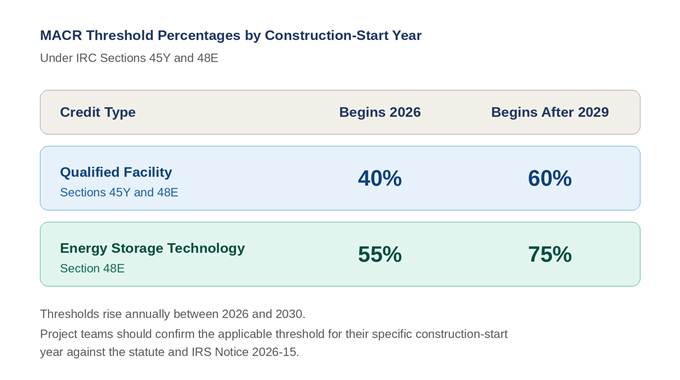
Notice 2026-15 allows taxpayers to calculate the MACR under general rules or to elect one of three interim safe harbors. There is no IRS-issued form for this calculation.
MACR compliance relies on supplier certifications signed under penalties of perjury. Verify that certifications come from each tier-one supplier, name the specific components, follow the Notice 2026-15 format, and are backed by audit-ready records. A meaningful number of 2026 deals have stalled when a manufacturer refused to sign — surface that risk early.
Pre-OBBBA agreement language is no longer sufficient. The transfer agreement should include:
Confirm separately whether tax credit insurance will cover FEOC risk and on what terms — policy language varies meaningfully on this point.
Fallbrook has spent more than two decades structuring tax credit transactions. The FEOC framework is new, but the discipline — knowing the project, knowing the counterparty, and reviewing every document — is not.
On every transferable energy credit transaction we facilitate, we pre-screen energy sponsors and projects in various ways, including initial diligence on FEOC compliance and various project safe harbors to ensure that the projects qualify for the credits they claim.
FEOC and Prevailing Wage & Apprenticeship (“PWA”) compliance are central diligence items in transferable energy credit deals today. Buyers who treat it as infrastructure will continue to access the credits they need at the pricing they expect.
To learn more email: team@fallbrookfinancial.com, with the subject line, “Meet with Justin!”
This article draws on primary IRS and Treasury guidance and on analysis published by leading tax and energy law firms.
Disclaimer: This article reflects guidance available as of June 2026, including IRS Notice 2026-15 and the One Big Beautiful Bill Act. Treasury and the IRS are expected to issue further FEOC-related guidance throughout 2026. Nothing in this article constitutes legal or tax advice. Buyers should consult qualified tax counsel before entering into any credit transfer.